Binance.US: Buy BTC & Crypto
- 3.3
- Rating
- 1.00M
- Installs
- Free
- Price

 Analysis by App-foxy
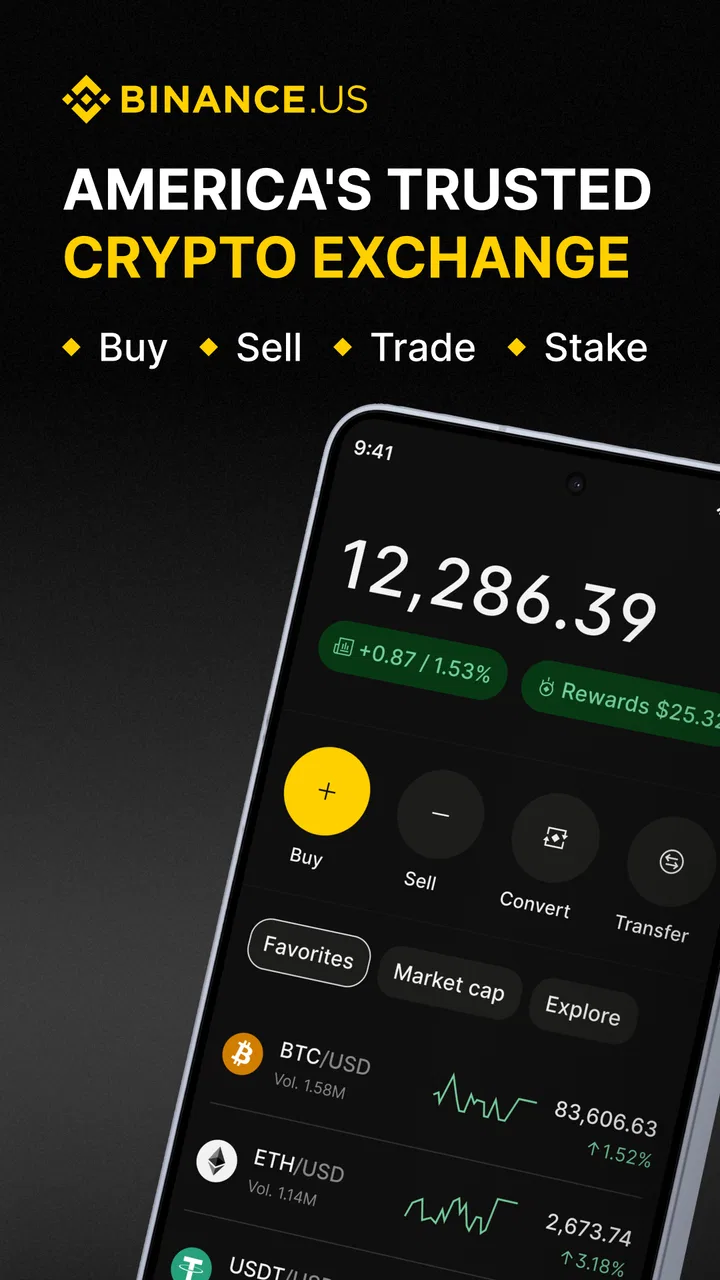
I approached Binance.US as a practical finance app rather than a place to chase every market move. Its purpose is straightforward: give people in the United States a mobile way to buy, sell, and trade cryptocurrencies such as Bitcoin, Dogecoin, and XRP. After spending time with that workflow, my impression is mixed but useful. The app can be convenient when I already know what I want to do, yet it demands more attention than a simple savings or investing app because every order involves changing prices, account security, and the possibility of losing money.
It is free to download, aimed at everyone from an age-rating perspective, and developed by Binance.US. The app has passed one million installs and holds an average rating of 3.0 from around eleven thousand ratings, with roughly 6.9 thousand written reviews. Those figures tell me something important before opening it: this is a widely used service, but its experience is not universally smooth. I would not choose it solely because it is popular. I would choose it when its crypto-focused tools match the way I intend to manage digital assets.
Starting with a repeatable buying and selling workflow
My preferred way to use the app begins before I place an order. I decide whether I am making a one-time purchase, selling an existing holding, or trading more actively. That small pause matters because the same screen can feel simple to a beginner while still representing a meaningful financial decision. I check the selected asset, review the amount, and make sure I understand whether I am entering a purchase or a sale before confirming anything.
You May Also Like

 Blood Strike: 2.5 Anniversary
Blood Strike’s Loadouts Turn Every Drop Into a Tactical Gamble
A close look at Blood Strike’s custom loadouts: how fast access to signature weapons reshapes its battle royale rhythm, rewards preparation, and narrows the gap between fights.

 Pandora - Music & Podcasts
Pandora’s Music Is Easy to Start, but Harder to Recover
Pandora’s strength is its low-effort path from a seed to a station. Its weak spot is how much confidence it asks you to place in connection, setup, and quiet recovery.

 8 Ball Pool
 Is Built on Rivalries, Rematches, and Routine
A close look at the rivalries, rematches, shared routines, and unanswered safety questions that turn a quick pool match into a persistent mobile community.

 Samsung Music
’s Quiet Strength Is Playing What You Already Own
Its reach comes less from spectacle than from dependable access to a personal library. That simplicity is both the app’s strongest retention engine and its ceiling.

 AccuWeather: Weather Radar
AccuWeather Review: A Quick, Clear Forecast for Everyday Decisions
For everyday plans, the best forecast is the one you can understand quickly. AccuWeather makes rain timing, radar, and local conditions easy to act on, with a few trade-offs.

 Hill Climb Racing
Why Hill Climb Racing Still Turns Crashes Into One More Run
A tiny car, a bumpy hill and one more upgrade: Hill Climb Racing keeps resurfacing because its simple chaos makes every near-miss feel personal.
More From Our News Desk



For a first-time user, the cleanest routine is to explore the asset page without immediately submitting an order. Bitcoin, Dogecoin, and XRP can attract very different expectations, so I would avoid treating them as interchangeable buttons. Bitcoin may be the asset a person recognizes most, while Dogecoin and XRP can appeal to users for different reasons and carry their own price behavior. The app makes access convenient, but convenience should not replace a personal reason for holding an asset.
I also recommend separating “funding the account” from “choosing the investment.” Those are two different decisions. Someone might add money because they want to be ready for an opportunity, then later decide that the opportunity is not attractive. Keeping that distinction in mind reduces the temptation to spend simply because funds are available. It is one of the most useful habits I found when treating the app as a tool rather than an entertainment feed.
A realistic everyday scenario would be a user who wants to make a small recurring purchase after payday. Instead of opening the app whenever a headline appears, I would set a personal schedule, open the relevant asset, review the current order details, and record why I am buying. The record can be as simple as a note outside the app. The point is to create a repeatable process that makes an emotional decision less likely when prices move sharply.
For selling, I would use the same discipline in reverse. I would decide in advance whether the sale is for taking profit, reducing exposure, or needing cash. That distinction helps prevent the common mistake of selling only because a short-term movement feels uncomfortable. Binance.US makes the transaction accessible, but it cannot decide whether the sale fits my wider financial plan.
The app is best suited to people who want direct access to crypto markets and are willing to review each action. It is less suitable for someone who wants a completely hands-off experience, automatic portfolio management, or the feeling of a conventional bank account. If my main goal were broad long-term investing across traditional assets, I would look at a general brokerage instead. If I wanted to hold crypto without checking prices often, I would still need a separate storage and security plan rather than assuming the exchange app solves everything.
What I check before confirming an order
My basic checklist is deliberately short. I verify the asset name, the direction of the transaction, the amount, and the final order details shown on screen. I also consider whether I am using money I can afford to leave exposed to market volatility. These checks sound obvious, but mobile interfaces encourage quick taps, especially when a price is moving.
I avoid making decisions from a single dramatic price change. A fast move can make a purchase feel urgent, while a sudden drop can make a sale feel necessary. Neither feeling is a reliable order strategy. The app gives me the ability to act quickly; that is useful when I have already made a plan, but risky when I am improvising.
Another practical habit is to keep the number of open decisions small. If I am comparing several coins, I write down what I am comparing instead of jumping repeatedly between screens and relying on memory. This is particularly helpful with assets that have similar-looking symbols or names. A few seconds of deliberate checking is worth more than recovering from an incorrect order.
Settings and account habits worth checking
Security deserves more attention than the trading screen. I would begin by reviewing every available account-protection option and choosing safeguards that I can actually maintain. A security feature is only useful if I understand how it works and can still access my account when I change phones, lose a device, or need to recover access.
I would also use a unique password for the account and avoid storing sensitive information in casual notes or screenshots. The app handles financial activity, so I treat login details differently from those for an ordinary social application. I keep my phone’s own lock enabled and avoid signing in on devices that I do not control.
Notifications are another setting area that deserves a thoughtful approach. I prefer alerts that help me notice account activity or important actions, while avoiding a constant stream of price prompts that can encourage impulsive trading. If every market movement reaches me as an interruption, I am more likely to react instead of follow my plan. The best notification setup is the one that improves awareness without turning the app into a source of pressure.
Before relying on the app for an urgent transaction, I would confirm that my account is ready for the kind of activity I expect to perform. Identity and account requirements can affect how smoothly a financial service works, and discovering a problem during a time-sensitive moment is frustrating. I would rather complete the setup calmly, read the on-screen instructions, and understand what is being requested than assume every feature will be immediately available.
One non-obvious but important habit is to review the destination carefully whenever I move crypto away from an exchange. I would never paste an address casually or treat a transfer like sending money to a familiar contact. The asset and network details need deliberate attention, because a mistake can be difficult or impossible to reverse. Even when the app makes the transfer flow look simple, the underlying action is not something I would rush.
I also keep records of significant transactions. A simple personal log can include the date, asset, amount, purpose, and confirmation information. This helps me understand my own behavior and makes later financial organization easier. The app can show account activity, but having my own clear notes is useful when I am comparing purchases over time or preparing information for tax-related work.
How I keep the app from controlling my attention
Crypto applications can become distracting because prices are available whenever I open the phone. I use a rule that I do not open the app merely because I feel curious or anxious. I open it for a defined task: checking an account action, reviewing a planned purchase, or making a decision that I have already considered.
This approach is especially valuable for beginners. A new user may confuse frequent checking with careful management, but watching a price does not make the investment safer. I would rather review my allocation at a planned interval and keep emergency money outside the app than let short-term movements dictate my day.
The current version is 3.32.0, and the app supports Android 7.0 or later. I would keep the operating system and application updated through the official store, while still reading update prompts carefully and maintaining access to the account’s recovery methods. Compatibility is broad enough for many older Android phones, but an older device may still provide a less comfortable experience than a recent one, particularly when security updates or performance become concerns.
Faster patterns for experienced users
Once the basic workflow feels familiar, speed should come from preparation rather than reckless tapping. I keep a short written plan for each asset I follow: what role it has in my portfolio, how much exposure I am willing to accept, and what would make me stop buying. When I open Binance.US, I can then compare the current situation with that plan instead of inventing a new opinion on every visit.
One efficient pattern is to separate research time from execution time. I might read and think away from the order screen, then use the app only after I have decided what I want to do. This reduces the chance that a sudden movement will change my mind at the last second. It also makes the app feel faster because I am not trying to perform analysis and transaction entry simultaneously on a small display.
Another useful pattern is to begin with a small test action when using an unfamiliar workflow. I would rather confirm that I understand the order process and account behavior with a modest amount than discover confusion after committing more money. This is not a guarantee against loss, but it is a sensible way to learn the interface while limiting the cost of a mistake.
For people who buy more than one asset, I recommend deciding how often the portfolio should be reviewed before opening the app. A scheduled review can reveal whether one holding has become too large relative to the original plan. The trade-off is that rebalancing can create additional transactions and possible tax consequences, so I would not rebalance simply because the colors or percentages look different on a given day.
Experienced users can also make better use of order review by slowing down at the final confirmation stage. The fastest traders I know are not necessarily the people who tap fastest; they are the people who make fewer avoidable errors. I check the order direction, amount, and asset one final time, especially when switching between several markets.
The app’s direct crypto focus is an advantage compared with a general finance application that treats digital assets as one small part of a broader account. I can approach crypto transactions without navigating unrelated products. On the other hand, a general brokerage may be better for someone who wants stocks, funds, retirement accounts, and crypto in one consolidated financial picture. Binance.US is more focused, but that focus also means I need another system for the rest of my finances.
Where convenience stops being enough
I would not mistake a polished transaction flow for professional trading infrastructure. A mobile app is excellent for checking a holding or making a planned transaction, but users with complex strategies may need more advanced tools, deeper market analysis, or a different platform entirely. The more complicated my method becomes, the more important it is to verify whether the app’s available controls actually match it rather than assuming that a familiar exchange name means every advanced function is present.
I am also cautious about using the app while traveling or on unreliable connections. I would not begin a sensitive transaction on public Wi-Fi or while distracted in transit. If a confirmation screen loads slowly, I wait and check the account state instead of repeatedly tapping. Repeated submissions can create confusion about what actually happened, and patience is often the safer shortcut.
Support expectations matter too. A finance app can be convenient most of the time, but a locked account, delayed action, or mistaken transfer becomes a serious problem. I keep my account information organized so that I can describe an issue clearly if I need help. I also avoid making a time-critical trade that depends on immediate assistance, because no mobile service should be treated as an emergency guarantee.
Advanced limits and the trade-offs behind faster trading
The biggest limit is not a missing button; it is the risk of making a high-speed financial decision with incomplete information. Crypto prices can change quickly, and an order that looked attractive moments earlier may no longer fit my plan. I therefore treat every market order as a decision with consequences, not as a harmless test.
Fees and transaction details deserve careful reading before confirming activity. I do not assume that the amount I type is the exact amount that will appear in my final holding or proceeds. The app presents transaction information during the workflow, and I use that point to review what I am actually agreeing to. This is more reliable than estimating from a headline price.
Tax organization is another advanced concern. Buying and selling can create records that matter later, even when each individual transaction feels small. My personal log helps, but I would still use qualified tax guidance for my situation rather than treating an exchange history as a complete answer. People who trade frequently should think about recordkeeping before their activity becomes difficult to reconstruct.
Storage is a separate trade-off. Leaving assets accessible in an exchange account may be convenient for someone who expects to trade, while long-term holders may think more carefully about custody and access. I would not move funds simply because another person recommends it, and I would not leave a large balance in an account without understanding the security and recovery choices involved. The right approach depends on how often I trade, how comfortable I am with self-custody, and how much complexity I can manage responsibly.
Dogecoin and XRP also illustrate why the app should not be treated as a neutral recommendation engine. Their availability makes them easy to access, but access does not tell me whether either belongs in my portfolio. I would research the asset independently, understand why I am considering it, and decide how much volatility I can tolerate. The same principle applies to Bitcoin, even though familiarity can create its own false sense of safety.
Someone who wants automatic investing, a simple cash balance, or a portfolio built around traditional funds may find a standard brokerage easier to understand. Someone who wants to experiment with crypto while keeping the amount controlled may appreciate the focused access here. Someone who cannot tolerate the possibility of losing a substantial portion of a speculative investment should skip crypto trading altogether, regardless of how easy the interface feels.
My practical rules for avoiding preventable mistakes
- Decide the purpose before opening the order screen. Buying, selling, learning, and transferring require different levels of attention.
- Review the asset and transaction direction twice. Familiar symbols can still lead to an incorrect selection when I am moving quickly.
- Use a personal transaction log. It improves portfolio awareness and makes later recordkeeping less stressful.
- Keep security and recovery details current. A secure account is not useful if I cannot regain access when my device changes.
- Do not let notifications become trading instructions. An alert is information, not a reason to act.
These rules do not make crypto safe, and they do not predict prices. They simply address the mistakes that are most likely when a convenient mobile workflow meets an emotional market. That distinction is central to my opinion of Binance.US: the app can simplify access, but the user still carries the responsibility for judgment, custody decisions, and risk.
My verdict after using it as a daily crypto tool
Binance.US is a focused finance app for people who want to buy, sell, and trade crypto from an Android device. I like its direct purpose and the fact that a planned transaction can be handled without the clutter of a full traditional brokerage. The free price and Everyone rating make it approachable, while its installed base shows that it is not an obscure experiment. Still, the average rating of 3.0 is a useful reminder to keep expectations realistic and to judge the experience against my own needs.
I would recommend it to a user who has researched crypto, wants a dedicated exchange app, and is prepared to build careful habits around security, order review, and recordkeeping. I would especially recommend starting slowly, separating research from execution, and using notifications as account awareness rather than market pressure.
I would not recommend it to a person looking for guaranteed returns, effortless wealth building, or a replacement for a bank account. I would also steer a highly active trader toward comparing specialist platforms if advanced order management and detailed analysis are central to the strategy. A general brokerage may be the better choice for someone whose finances extend well beyond crypto.
My final view is that the app works best when I use it as a controlled doorway to digital-asset transactions, not as a constant source of market stimulation. The strongest workflow is simple: plan outside the order screen, verify every detail inside it, protect the account, and keep independent records. The real advantage is disciplined access, not speed by itself. Used that way, Binance.US can be a practical option for crypto-focused users, while its limitations become much easier to recognize before they turn into expensive surprises.
FAQs for Binance.US: Buy BTC & Crypto
01What features does the Binance.US app offer?
The Binance.US app provides a comprehensive platform for trading a wide variety of cryptocurrencies, including BTC, DOGE, and XRP. Users can access real-time market data, advanced charting tools, and various order types. The app also supports staking, allowing users to earn rewards on their holdings, and offers educational resources for both beginners and experienced traders.
02Is Binance.US safe for cryptocurrency trading?
Yes, Binance.US employs stringent security measures to protect users' funds and personal information. Features include two-factor authentication (2FA), device management, and withdrawal whitelist options. The platform is compliant with U.S. regulations and undergoes regular security audits to ensure that the environment remains secure and reliable for all users.
03What are the fees associated with using Binance.US?
Binance.US offers competitive fees compared to other cryptocurrency exchanges. The trading fees are generally 0.1% per trade, but users can receive a 25% discount when paying with BNB, Binance's native token. Additional fees may apply for deposits and withdrawals, depending on the method used, so it's important to review the fee schedule on their website.
04Can I use Binance.US on multiple devices?
Yes, Binance.US supports usage across multiple devices, including smartphones, tablets, and desktops. The app is available for both Android and iOS, and users can seamlessly switch between devices. However, it's important to enable security features like two-factor authentication to ensure account safety when accessing from different devices.
05How do I get started with Binance.US?
To start using Binance.US, you need to create an account by providing a valid email address and verifying your identity with required documentation. Once your account is approved, you can deposit funds using various payment methods such as bank transfers or wire transfers. After funding your account, you can begin trading and exploring the app's features.
Pros
- User-friendly interface for beginners.
- Wide range of cryptocurrencies available.
- Low trading fees compared to competitors.
- Advanced security features implemented.
- Real-time market data and updates.
Cons
- Limited availability in some U.S. states.
- No margin trading options available.
- Customer support can be slow to respond.
- Lacks some advanced trading tools.
- Withdrawal fees can be relatively high.

Binance.US: Buy BTC & Crypto
Gallery